


His work “Power vs. Force: The Anatomy of Consciousness” (Veritas Publishing, 1995) provides a comprehensive explanation of this theory.
This scale designates each level of consciousness to different human behaviors and world and spirituality perceptions. The scale is measured in logarithmic values, indicating the levels of human consciousness and their manifestation in reality.
According to Dr. Hawkins, there are two major consciousness thresholds: 200 and 500. The 200 threshold symbolizes the courage level, denoting a significant change from self-destructive behaviors towards a balanced life. Around 78% of the population falls below this level, which impedes the evolution of human consciousness.



However, Dr. Hawkins points out that one person at level 600 can counterbalance the negativity of 10million people below the 200 level due to the logarithmic nature of the scale.The next threshold stands at level 500, synonymous with the love level. As interpreted here, love represents a state of being. Only 4% of the global population reaches this level, indicating a progression towards spirituality.
Dr. Hawkins maintains that an individual’s consciousness level remains relatively constant throughout life. While emotions can fluctuate, the consciousness level is governed by specific energy fields that generally remain unchanged unless the individual becomes aware of their behaviors and seeks change.
The consciousness scale spans multiple levels, ranging from Shame (below 30), where humiliation is dominant and suicide thoughts are common, to Enlightenment (700-1000), the pinnacle of human consciousness, achieved by significant historical figures like Jesus, Buddha, Krishna, and others. Intermediate stages include Guilt, Apathy, Grief, Fear, Desire, Anger, Pride, Courage, Neutrality, Goodwill, Acceptance, Reason, Love, Joy, Peace, and Enlightenment.


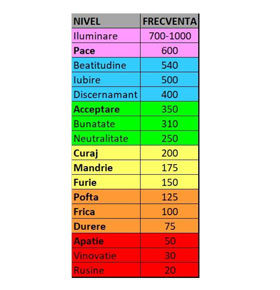
It is important to mention that these levels are not static, and a person can evolve or devolve throughout their life, depending on their experiences and choices. Additionally, it is possible to experience different levels of consciousness at different times or in different contexts.
Dr. Hawkins’ theory is not an absolute reality, but it can be used as a framework for better understanding our experiences and guiding our personal and spiritual development.
In addition to the levels of consciousness described by Dr. Hawkins, it is interesting to reflect on how these levels can manifest in everyday life.
For example, individuals who are at the Fear level (100-199) can be very cautious and defensive, as fear dominates their behavior. They may feel that the world is a dangerousand uncertain place, and that they must always be on guard.
People at the Pride level (175-199) can be extremely competitive and may be very concerned about their social status and recognition. They may tend to feel superior to others and criticize those who do not conform to their standards.
At the Courage level (200-249), people start to become more confident in their own abilities and feel capable of facing life’s challenges. They begin to realize that they have control over their own destiny and start to take responsibility for their own lives.
At the Love level (500-539), individuals become capable of unconditional love and deep empathy for all those around them. They begin to see the beauty in all things and appreciate every moment of life..
Finally, at the Enlightenment level (600-1000), individuals reach a level of consciousnesswhere they feel in complete harmony with the universe. They understand that everythingis interconnected and that there is a greater purpose in all things.
This is the lowest consciousness level, dominated by feelings of shame and humiliation. Individuals at this level feel rejected and unwanted and often contemplate suicide.
This level is ruled by guilt. Individuals at this level feel they’ve done something wrong and punish themselves.
People at this consciousness level feel powerless to change and lack hope.
This level is marked by despair and sadness. Individuals here often feel depressed.
Fear dominates this level. Individuals here are scared of risks, changes, and the unknown.
This level is controlled by desire and greed. Individuals here always want more and never feel satisfied.
This level is dominated by anger. Individuals here tend to be aggressive and frustrated.
Pride rules this level. Individuals here feel superior to others and tend to belittle those they perceive as “less.”
This is the first positive consciousness level. Individuals at this level feel they can handle life’s challenges and have self-confidence.
People at this level feel safe and comfortable. They are not as affected by life’s ups and downs and live a peaceful life.
People at this level are kind-hearted and wish others well. They have the will to improve themselves and help others.
At this level, people accept themselves and others. They have an understanding of themselves and the world around them.
People at this level are objective and rational. They have a thirst for knowledge and truth.
Love, as a state of being, dominates this level. People at this level are unconditionally loving, forgiving, and accepting of others.
Joy rules this level. Individuals here live in a state of perpetual joy andgratitude.
This level is dominated by a profound sense of inner peace. Individuals at this level perceive the world as beautiful and live in harmony with it.
This is the highest consciousness level. It is achieved by historical figures such as Buddha, Jesus, and Krishna. Individuals at this level areaware of the oneness of all life and live in a state of bliss.
These levels of consciousness can help us better understand our behaviors and emotions, and guide our personal and spiritual development. They can also help us better understand others and treat them with more compassion and understanding.
Within these levels of consciousness, there is a wide range of emotions and behaviors that people can experience. One of the important aspects of this system is that it is not static – people can fluctuate between different levels of consciousness depending on their life experiences and how they choose to relate to them.
t is also essential to underline that, although certain levels may seem “better” or “higher” than others, all are part of the human experience and all have their value. For example, the “lower” levels of consciousness can be fertile ground for learning and growth, as they can challenge us to confront our fears and limitations and overcome them.
An important aspect to remember is that these levels of consciousness are not “good” or “bad” in themselves – they are simply indicators of how a person perceives the world and reacts to it. The aim is not necessarily to reach a certain level, but to develop our consciousness in a way that is aligned with our personal values and aspirations.
Another important point is that, although Dr. Hawkins developed this scale, there is no “definitive method” to determine a person’s level of consciousness. This is a source of guidance and understanding, not a judgment or evaluation tool.
In the end, improving our consciousness is a continuous process that requires reflection, practice, and commitment. The more aware we are of ourselves and the world around us, the more capable we are of living a life full of meaning and satisfaction. I will continue to explore the implication of levels of consciousness in different areas of life.
In relationships, consciousness plays a vital role in how we relate to each other. Lower levels of consciousness can lead to relationships dominated by fear, manipulation, and dependence. On the other hand, higher levels of consciousness allow for a relationship based on love, respect, and autonomy.
In career and work, the levels of consciousness are reflected in how we approach our work. Lower levels of consciousness can lead to a competitive attitude, stress, and burnout. Higher levels of consciousness allow for a broader perspective, allowing us to see our work as a contribution to a greater good, not just a means of earning an income.
In health and well-being, the levels of consciousness influence how we take care of our body and mind. Lower levels of consciousness can lead to neglecting health and well-being, while higher levels of consciousness support a holistic and balanced approach toself-care.
At the global level, levels of consciousness influence how we see the world and how we engage in global issues. Lower levels of consciousness can lead to an “us versus them” mentality, while higher levels of consciousness promote a vision of unity and global cooperation.
As we develop our consciousness, we can make positive changes in all these areas of life. We can also begin to see the world in a new way, realizing that we are all interconnected and that our actions have an impact on others and the world in general.
Higher levels of consciousness allow us to experience a deeper connection with others, the world, and ourselves. This can lead to a number of benefits, such as:
In conclusion, increasing our level of consciousness allows us to see the world from a broader and deeper perspective. This can have a positive impact on numerous aspects of our lives, from relationships and career to health and well-being.
Now think of all the benefits I’ve described. Wouldn’t it be wonderful to experience a deeper connection with the world, to become more compassionate, more understanding, and to live a life full of harmony and joy? It’s time to take action and develop our consciousness. Take the first step in this transformative journey and schedule a session with us. Be the leader of your own evolution. Schedule now and startthe journey to a higher level of consciousness!